I like my leaves cooked

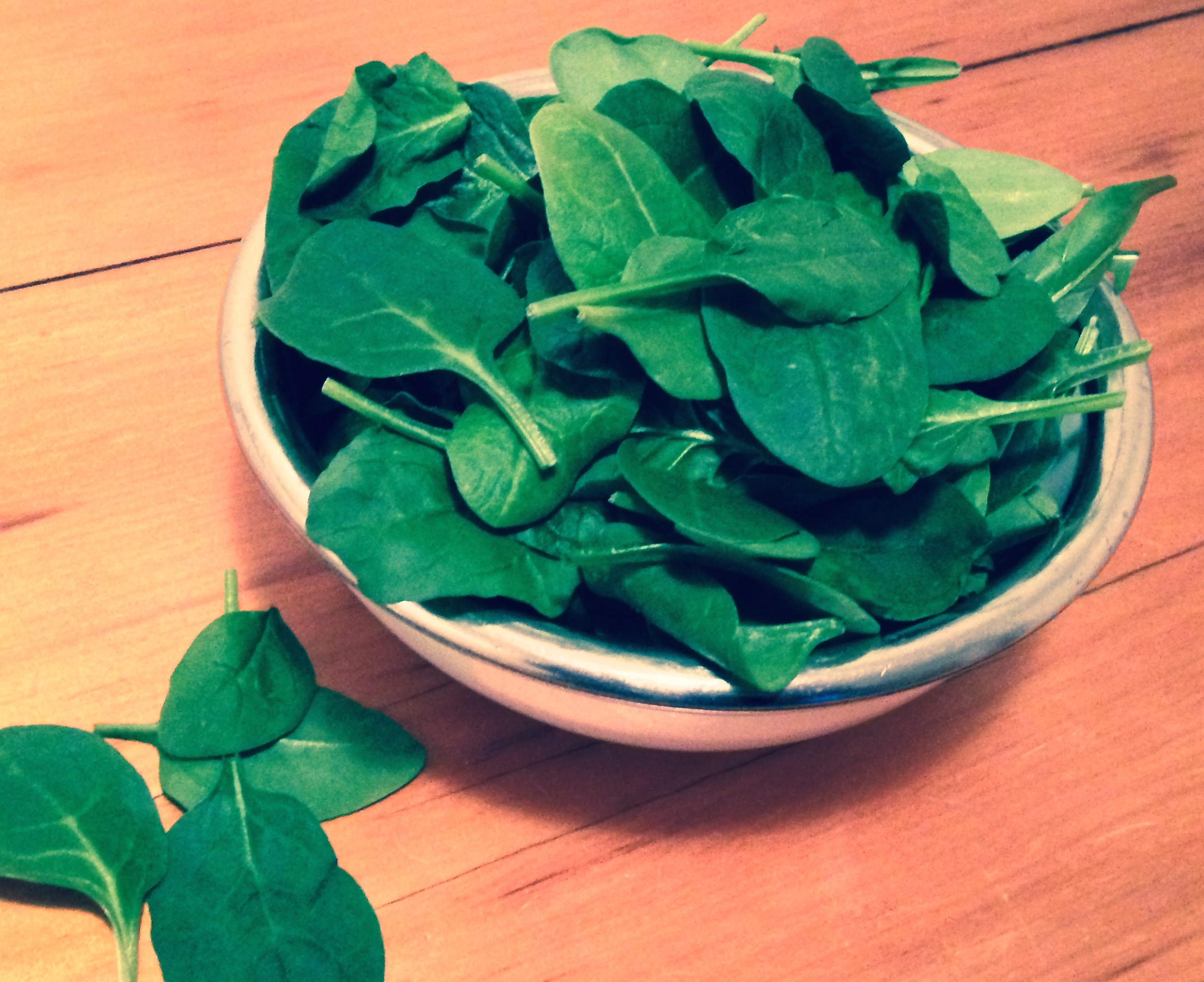
Café spinach is tricky. I’ve learnt to ask now before ordering: is the spinach cooked or raw? Because I love it cooked but dislike it raw. I agree a hundred per cent with Mark Bittman, who wrote in The New York Times a couple of years ago, that Spinach is a Dish Best Served Cooked.

Spinach: does anyone really love eating it raw?

IMG_0716

I imagine those mixed leaf salads every café and bistro seems to serve—at least in Sydney—are cheap and easy to throw together. No cooking skill required, and here’s hoping half a plate of miscellaneous leaves will disguise the smallness of the accompanying quiche or pie or whatever. One café lunch—before I got wise to the raw spinach thing—I ordered smoked salmon. When it arrived you needed a search party to find it amongst the acres of salad leaves.

It would be a real pity if this preponderance of raw leaves put people off spinach because it’s a wonderfully versatile and tasty vegetable. As well as a nutritious one. And it’s so quick to cook. Stir-fry it with garlic and chilli; steam it and serve with pepper, nutmeg, grated Parmesan and the merest dash of butter or light cream; steam and serve cold as a Korean style side-dish with drizzles of sesame oil and soy. Mix it with cheese, egg and parsley in a Turkish börek or a Greek spanakopita. And saag aloo, a dry spinach and potato recipe from northern India is simple to make and a sure-fire favourite.

Spinacia oleracea originated in Persia and the name ‘spinach’ comes via Arabic from an old Persian word aspanākh.

When I was first in Australia, what’s called English spinach wasn’t widely available. I had to substitute silver beet, which is fine in itself (I like all leafy greens if they’re cooked) but it has its own taste and texture and they’re not the same as Spinacia oleracea. Luckily the spinach called English is now in ready supply. Is it Asian cooks and market gardeners we have to thank for this? I bet it is.

The only other thing to say about spinach is that it’s a terrible shrinker. When you cook it, it reduces to less than 15% of its original volume. Which may be why so many restaurants and cafés opt to serve it raw—no shrinkage.

More cheese in art

I was in Amsterdam for a couple of weeks in July. It reminded me how much I’ve always liked the city—although July is not the best time to visit. I was last in the Netherlands about 6 or 7 years ago, and my culinary memories of that stay are packed with bread and sandwiches. This time I wanted to go to town with the cuisines of former Dutch colonies—Indonesia and Surinam in particular. The food and cooking of the Indian subcontinent is everywhere in Britain, so I assumed it would be easy to find plenty of what I was looking for in Amsterdam. Not so. Maybe I was in the wrong part of the city? Maybe the cuisines of its ex colonies haven’t had much impact on Dutch eating and food culture? Maybe I need to do more research before any future trip?

So I more or less gave up on that quest and resigned myself to a fortnight of bread, bread, and more bread. Look, the Dutch do bread well, especially fruit breads, but there really are only so many sandwiches a girl can eat.

Prayer without End

I went to the Rijksmuseum to look at their still lives. Early to avoid the crowds and queues. I found less cheese on the walls this time. This painting of an elderly woman at prayer by Nicolaes Maes is titled Prayer without End. Hmm … could she be praying for a meal that doesn’t involve a lot of bread?

The only other ‘cheese painting’ on display was one from about 1615 by Floris Claesz van Dijk. More generally, I noticed that as well as peel, cracked nuts and half apples, all manner of hungry insects populated these seventeenth century still lives. Reminders of the propinquity of death and decay.

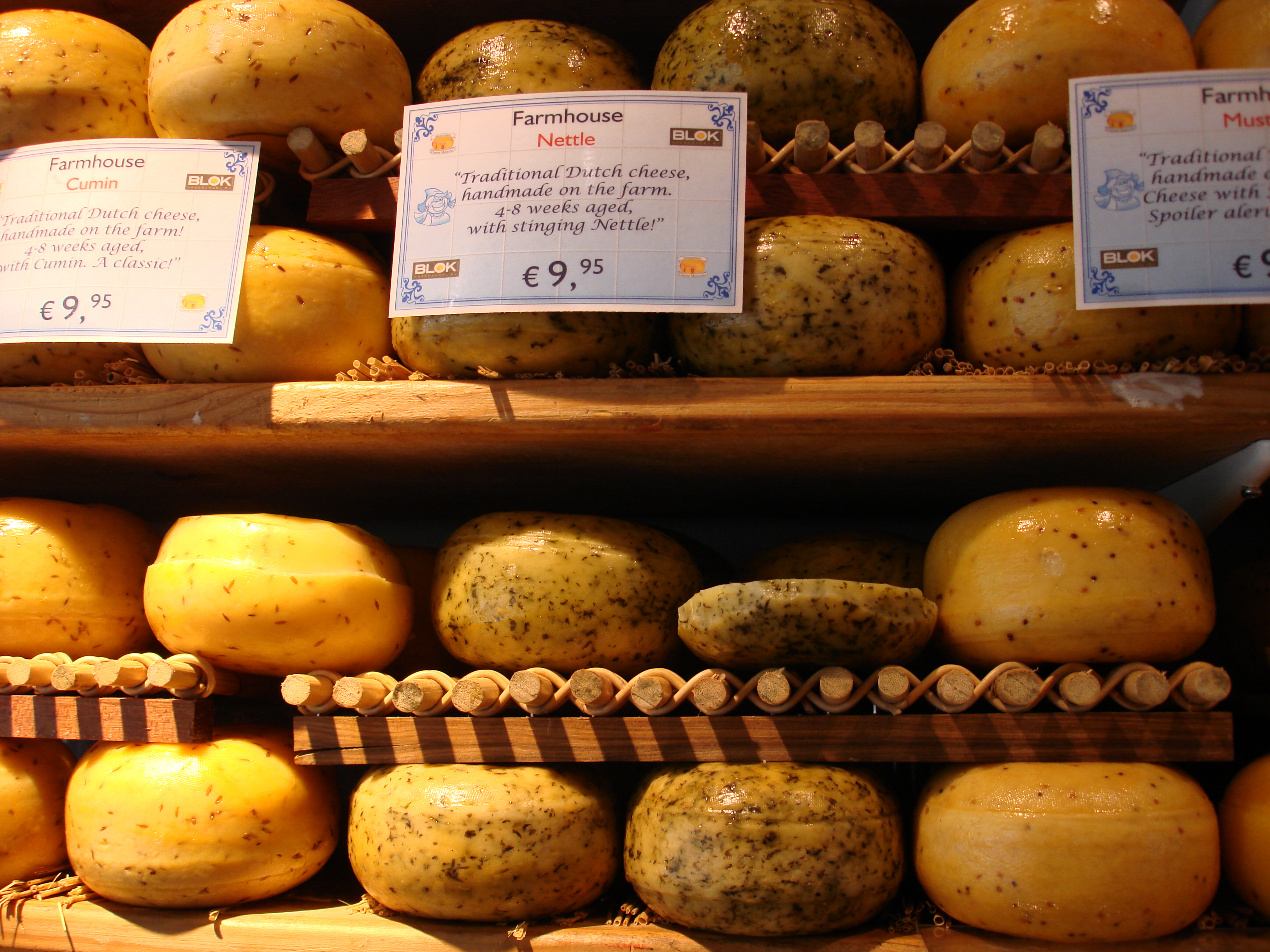
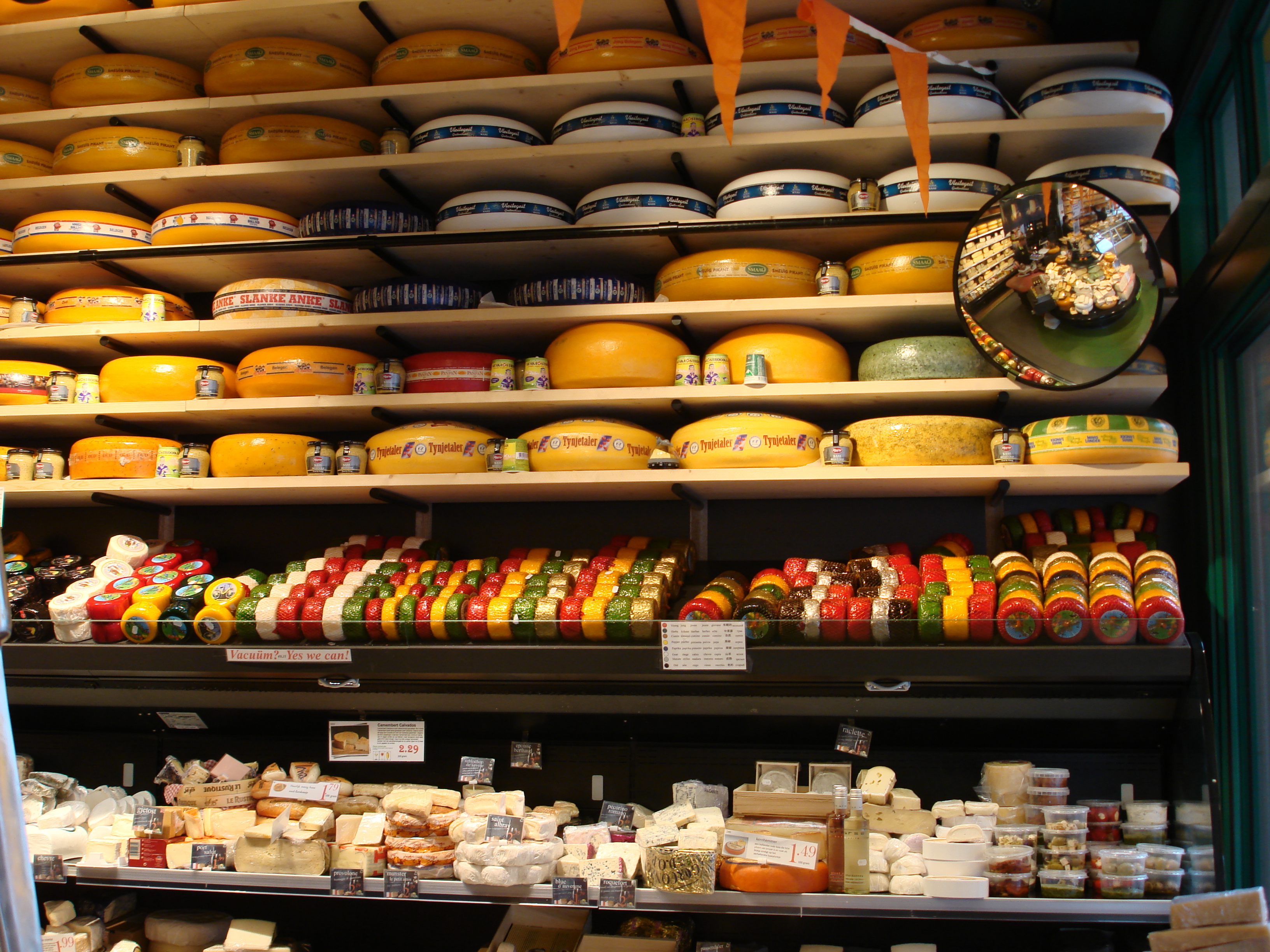
After slim pickings on the cheese in art front I turned my attention to the artistry of cheese shops. The produce on offer was green, red, orange, brownish, almost white, and every shade of yellow. Row upon row of Edam and Gouda flavoured with different herbs, spices and weeds. Given my interest in edible weeds, of course I had to try what was described as a farmhouse lunch cheese made with nettles. And yes, it did taste very good.

DSC00010

In the absence of Indonesian or Surinamese dishes, I organised my culinary itinerary around fruit breads and cheeses.

DSC00007

Hazel nuts

In my hierarchy of nuts, hazels are top. Followed by almonds, walnuts, and Brazils—after eating them in Brazil and realising they’re poor travellers. Macadamias are also good, but pecans and pistachios I can take or leave.

Although hazelnuts seem made for chocolate, gelato, praline and all things sweet, they also work well in savoury dishes—with pork, zucchini, green beans or mushrooms. Add a drizzle of hazelnut oil to mushroom risotto just before serving. Stuff zucchini with crushed hazels, breadcrumbs, ricotta and herbs.

Corylus is a genus of about a dozen-plus deciduous trees all native to the Northern Hemisphere. Corylus avellana, the common hazel (or filbert or cob nut) is an understorey tree found from Scandinavia to the Mediterranean. One of the first trees to colonise the land after the retreat of the glaciers at the end of the last Ice Age, it is a hardy plant, well-adapted to life in colder climates. The trees don’t have a single trunk, but instead a number of branching shoots, which can make them look more like a shrub than a tree. Unless coppiced, they last around 70 years—that’s short-lived by tree standards.

We have a long relationship with the hazel. Norse, Celtic and Roman mythologies identified it as the Tree of Knowledge. Elsewhere it variously aided fertility, warded off evil spirits and divined water. The wood of Corylus avellana is pliant; it could be bent into wattle walls and fences, woven into baskets and planted as hedgerows. While the nuts are a good source of protein and rich in unsaturated fat—one of humankind’s survival foods. In the enlarged and amended 1636 edition of Gerarde’s The Herball or Generall Historie of Plantes, he writes that ‘this kernell is sweet and pleasant unto the taste.’ But warns that ‘Hasell Nuts newly gathered, and not as yet dry, containe in them a certaine superfluous moisture, by reason whereof they are windy.’ And not only digestive problems, but also headaches ‘when they be eaten in too great a quantity.’

Hazels from Gerarde's Herball, 1636

Hazels from Gerarde’s Herball, 1636

I grew up with hazelnuts. Kids’ stories about dormice hoarding them for their winter hibernation; picking bunches of yellow catkins (the hazel’s male flowers) to compliment the first snowdrops of spring; roasting the nuts on trays in the oven before grinding them to meal for baking, or to sprinkle on porridge (something I still do); fighting a losing battle with grey squirrels. Trying to gather wild hazelnuts you had to move fast. If you were lucky you might get a handful, but more often than not you’d find grey squirrels had got there first and taken the lot. Oliver Rackham (The History of the Countryside) writes that because of these animals: ‘Hazel, which has shaped our civilisation from prehistoric times, is the most seriously threatened British tree except elms.’ That makes me think of Wordsworth’s Nutting, a blank-verse narrative about a young man’s trek through the woods in search of hazelnuts—written around 1800 before the introduction of grey squirrels to the UK. The poem has a kind of fairytale, Brothers Grimm, quality. After thorns and brambles and ‘pathless rocks’ the young adventurer finds the treasure he’s after.

‘ … the hazels rose
Tall and erect, with milk-white clusters hung,’

Hazelnuts were brought to Australia by early settlers and by returning soldiers and travellers, and planted in a pretty ad hoc manner. The nuts they produced were unsuitable for commercial farming, and for a long time our (modest) domestic demand was met by imported nuts. It was the enthusiasm and pioneering work of a Hungarian immigrant that changed the nuts’ Australian profile. Imre Tokolyi arrived in Melbourne in 1957. To earn a living, he and his wife started baking and selling biscuits. He could find almonds and walnuts to flavour them, but not his favourite hazelnuts—so he decided to grow his own. And in 1981 The Age reported that ‘after 25 years of experiments and dedication, Imre Tokolyi’s dream—to develop hazel nuts as a significant crop in Victoria—is about to come true.’

Here the competition isn’t from squirrels, but nut-loving cockatoos and possums.

A couple of weeks ago I bought some Victorian-grown hazelnuts from The Nut Shop in Sydney’s Strand Arcade. Complex, mellow and very moreish. Plus there’s something I love about those pocket-sized, CBD dried fruit and nut shops—it was a sad day when the Ditters store in Adelaide’s Gawler Place closed.

Of course it’s hard to discuss hazels without mentioning Nutella. Last month I read that the makers of Nutella, the Italian chocolate and confectionary company Ferrero, are investing in a huge hazelnut plantation in the Riverina—sweet news for struggling citrus farmers. I was a fan of Nutella until I checked its ingredients and realised that for all the marketing of it as a healthy breakfast option, it’s about 70% fat and sugar.

I wanted a chocolate hazelnut spread that was lower in sugar, higher in nuts, and with fewer nasties like palm oil. There are heaps of homemade ‘Nutella’ recipes on the internet, but this is what I came up with:

About 170 grams hazelnut butter or spread—one that’s 100% hazels.
50 grams good quality chocolate. I use Green & Black’s organic milk.
1 tablespoon of pure cocoa.

Melt the chocolate, mix well with the hazelnut butter and cocoa. Store in the fridge, but remove about half an hour before you want to eat it.

Let them eat kale

Foods go in and out of fashion. Right now kale and salted caramel are cool—cool being the operative word, because kale thrives in cold weather. It relishes overnight frosts; chilly conditions only strengthen its resistance (to pests) and improve its flavour.

No surprise then that it’s so closely associated with Scotland. There kale, or kail as the Scots usually spell it, not only denotes the vegetable itself, but is also a synonym for broth, or even supper. Not to mention the literary movement dubbed the ‘kail-yard school’. This refers to a group of late nineteenth century novelists, the best-known of whom is J M Barrie of Peter Pan fame, who wrote stories of lowland life in Scots dialect.

Originally from the Mediterranean, grown by the Romans and likely spread by them during the course of their imperial conquests, according to Samuel Johnson, kale wasn’t actually introduced to Scotland until the latter half of the seventeenth century:

‘I was told at Aberdeen that the people learned from Cromwell’s soldiers to make shoes and to plant kail. How they lived without kail, it is not easy to guess; they cultivate hardly any other plant for common tables, and when they had not kail they probably had nothing.’ (Journey to the Western Isles of Scotland, 1775)

‘There’s cauld kail in Aberdeen
And castocks in Strathbogie … ’

‘Cauld kail’ is cold soup and ‘castocks’ are cabbage stalks, and those lines are from a song collected by Robert Burns in the latter half of the eighteenth century. A keen collector of lyrics, Burns often revised and extended them with verses of his own.

Kale and cavolo nero, 2013

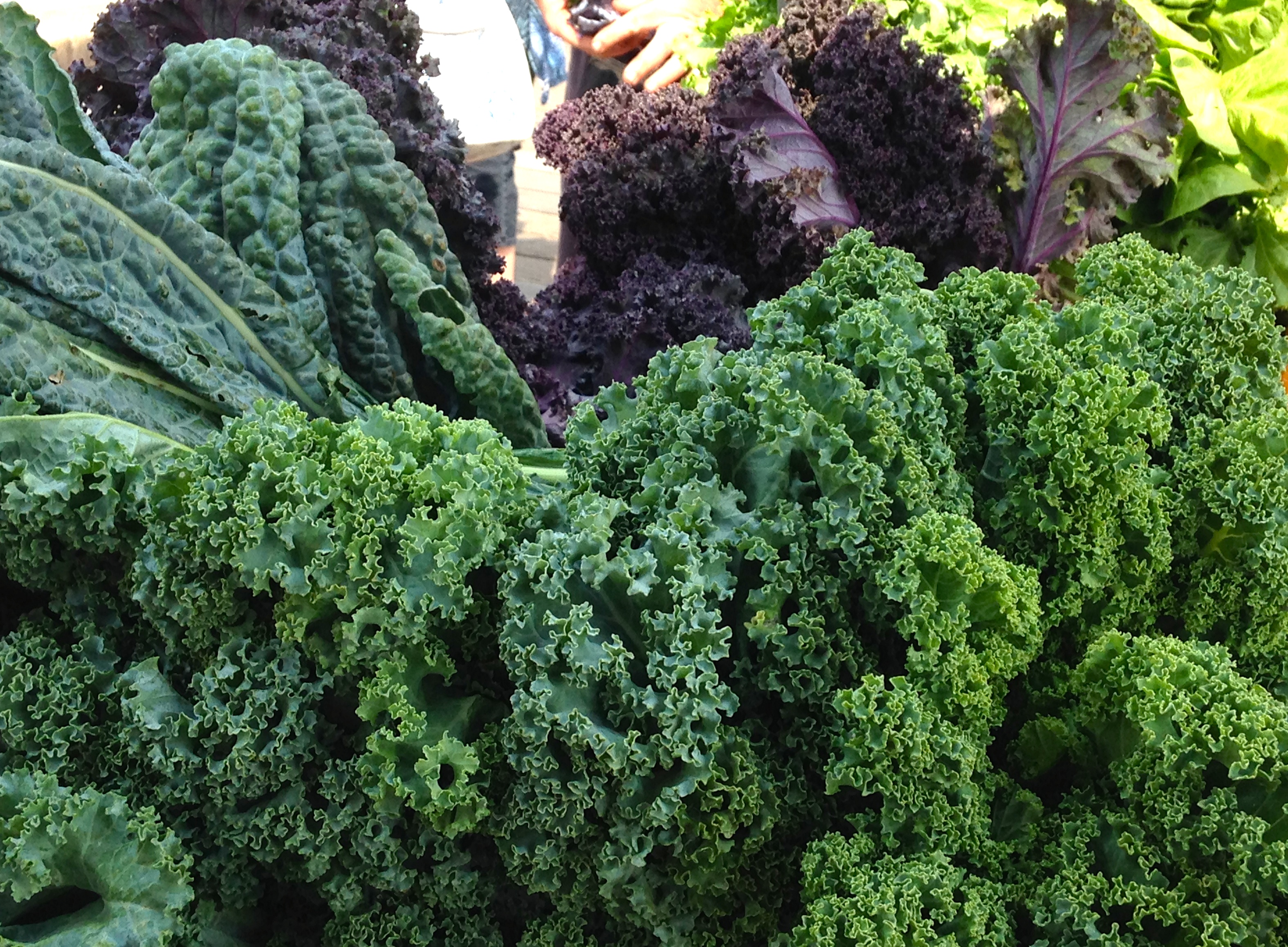
Brassica at its most basic—that’s kale or borecole as it’s sometimes known. It’s descended from the same wild ancestor as cabbage, but of the two, kale is the more primitive expression. At school we learnt that European peasants of the Middle Ages had a pretty miserable existence and lived on roots and tough, bitter-tasting leaves. Now I’m older and more widely read in history and matters culinary, I know that the roots were root vegetables and the leaves were kale. Not only because kale survives whatever the elements throw at it, but because ‘headed’ or ‘hearted’ cabbages weren’t developed until the end of the Middle Ages.

I have a soft spot for those hardy, northern vegetables. Kale leads me down a dimly-lit path to a library of unusual Scottish words. As well as a hardcore fudge called tablet, there’s dreich which means dreary, as in: It was a grey, dreich November day. Drookit for soaking wet. And my favourite Scottish word, peely-wally, which means pale or off colour.

Dwarf curled Scotch; True Siberian; Red Russian; Winterbor. The names of some kale cultivars signal their cold climate provenance. There’s also a variety called Hungry Gap, the super tall Jersey Walking Stick (which can grow over 3 metres!) and Dinosaur Kale, better known as Cavolo Nero or Tuscan cabbage.

According to Jane Grigson, kale is one of ‘the nastier aspects of the cabbage clan.’ I don’t agree with her, but echoes of that parental refrain ‘eat up your greens’ do surround it. Or did before kale’s makeover. Championed by chefs, celebrities, and celebrity chefs, kale flipped from worthy to trendy. Now it’s everywhere: high end providores, local food fairs, farmers’ stalls, green grocers, even supermarkets.

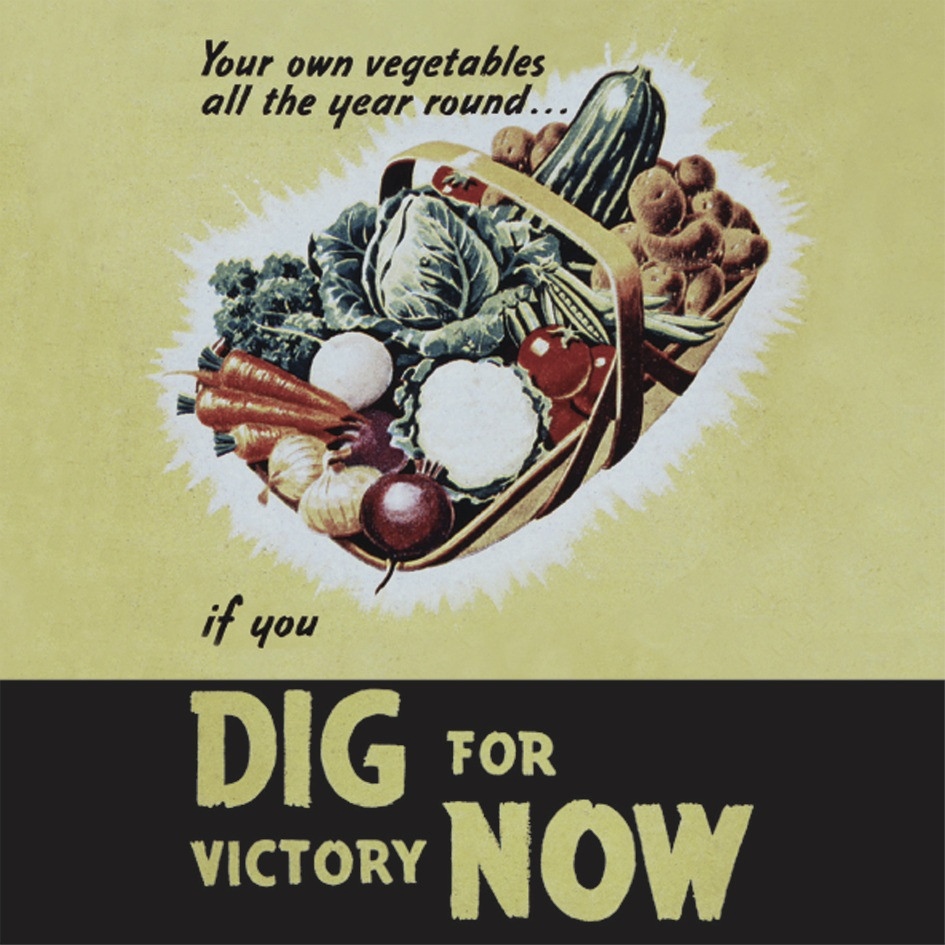
Until kale’s recent narrative shift it reeked of institutional catering and poverty. Boiled cabbage together with stale air and piss were the signature smells of institution corridors. It was cattle fodder. Or belonged to the foodscapes of the poor: a cheap but nutritious ingredient in Irish colcannon, Portuguese caldo verde, or Dutch boerenkool met worst—kale mashed with potatoes and served with smoked sausage and mustard. It enjoyed a brief respite during the second world war’s Dig for Victory campaign when the public were encouraged to transform gardens, parks and sports fields into allotments to grow vegetables.

Dig for Victory image

With its frilly petticoat leaves, a bunch of curly kale is a tempting purchase. The first time I bought some I ended up not cooking it, but using it in a flower arrangement. The next time, I did some research. Because I found the idea of green shakes or raw salads unappealing, I went looking for older recipe ideas. In The Cookery Book of Lady Clark of Tillypronie from 1909 I found Sir John’s Luncheon Kale which pulverises the cooked leaves and blends them with butter and cream. The Scots Kitchen: Its Traditions and Recipes by F Marian McNeill (1929) was an informative read, but suggestions like this one I found as unappetising as Gwyneth Paltrow’s grassy-tasting breakfast juice:

‘Put half an ox head or cow heel into a goblet with three quarts of water. Boil til the fat floats on the top. Take a good stock of kail, wash it carefully and pick it down very small, and put it into the broth … ’

After some experimenting and adapting, I came up with Pasta With Red Hot Kale. It goes like this: Blanche your kale or boil it for a minute, stalks and spines removed. Then cut it up small, and while your pasta (I use rigatoni, fusilli, or penne) is cooking, fry a couple of finely chopped red chillies and 2-3 cloves of garlic in olive oil. Add the kale, and sauté for a few minutes. Stir in ½ teaspoon of paprika—more if you wish. Season. Drain the pasta and add it to the red hot kale. Remove the pan from the heat, stir in some halved or quartered cherry tomatoes, a tablespoon or 2 of crème fraîche and about the same amount of grated Grana Padano. Mix up and serve with shavings of Grana Padano to taste.

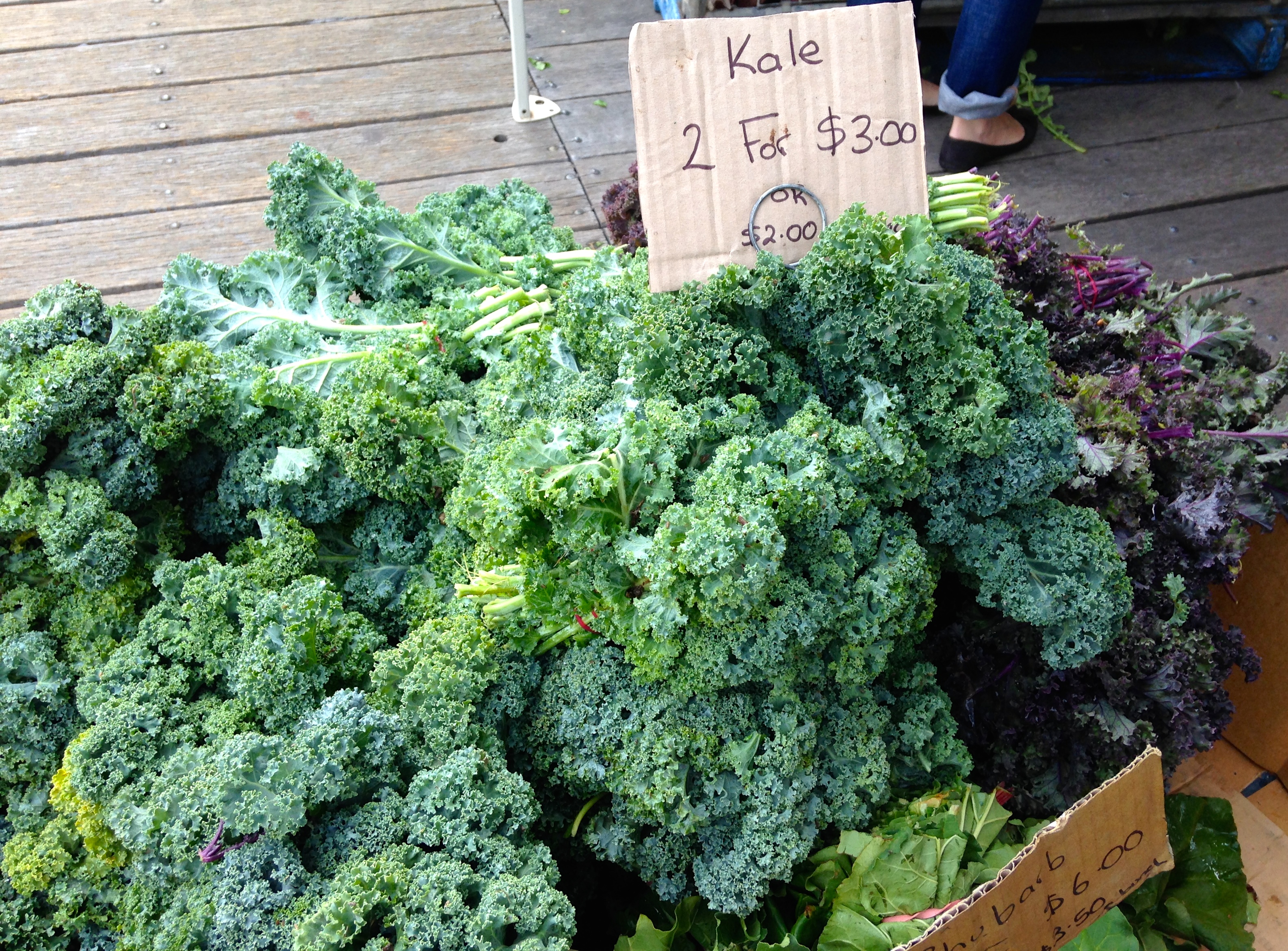
Kale for sale at Pyrmont market 2013

Charles Darwin was fascinated by cabbages and their kin. ‘Every one knows how greatly the various kinds of cabbage differ in appearance,’ he wrote inThe Variation of Plants and Animals Under Domestication. Later warning of their reckless promiscuity: ‘great care must be taken to prevent the crossing of the different kinds.’ If the pollen of the various brassicas intermixes centuries of selective breeding can come undone. Plant a cauliflower—get a load of kale.

Happy Birthdaycake

Amazingly, no one took a photograph. We were all too busy eating it to whip out our smartphones and record the cake of the moment. So here’s a picture’s worth of words instead: Iqbal, the friend and colleague who made it, described it as an Italian-style (flourless) chocolate cake. It was rectangular, party-size (i.e. large) and dusted with cocoa powder. Flavour-wise, it was rich, moist, dark and intense—and most importantly, it tasted of chocolate, something you can’t always take for granted in a chocolate cake.

It got me thinking about chocolate cakes more generally—Black Forest, devil’s food, chocolate babkas, Mississippi mud, and the most famous of all: Sachertorte. Created in 1832 by an apprentice pastry chef, it’s probably the only cake to spark a court case. The dispute between the Hotel Sacher and the Demel Bakery was about who had the right to use the label ‘The Original Sachertorte’. After years of bitter legal wrangling, an out of court settlement was reached in 1963.

Lindt cafe display, Dec 2013

A slice of Mitteleuropa in Sydney—the Lindt Café display

Vienna, early February 2004. Snow on the ground and more to come. Kathryn and I make the obligatory pilgrimage to the Hotel Sacher for its eponymous cake. The surroundings are grand—brocade wallpaper and crystal chandeliers, the service is efficient, the tea excellent, but the cake … the cake is an anticlimax. It’s dry. I don’t usually eat cream with cakes, but perhaps a Sachertorte needs that dollop? And although it looks the part, it doesn’t pack the cocoa hit I’m after.

Things aren’t always how they seem.

Vienna is a fairytale, a city of nuts, of glacé fruits and marzipan, of cafés and Konditoreien, a place where there’s a cake around every corner. But it’s also a city of fur coats and resurgent far-right politics, a city of ghosts, some deader than others.

Our pilgrimage to the Hotel Sacher is actually twofold. We’re here for the famous cake of course, but we’re also here because of a film. This is where The Third Man was cooked up. In February 1948 Graham Greene checked into the hotel with a vague idea for a screenplay. (And it’s where his fictional protagonist, Holly Martins, stays in Vienna.) The Third Man is close to the top of my list of all time favourite films. For the way it assembles and reassembles the war-ravaged city to create its narrative of shadows and surveillance, for the way it suggests rather than shows. And because the film and its production story shed light on what happens when a European penchant for paradox and ambiguity butts up against an American urge to explain and reassure.

The Third Man posterThe Third Man-Hotel Sacher

A number of cooks and food writers divide chocolate cakes into 2 categories: the more gooey, dessert-style ones, and the drier, understated ones—like chocolate babkas and Sachertorten.

Sachertorte is available almost everywhere in Vienna, from railway cafeterias to elegant coffee houses. So I decide to give the cake a second chance … then a third, and after several samplings I come to admire its grown-up restraint. Not all chocolate cakes need to involve alcohol, cherries, praline, layers of cream or hours of refrigeration. But although the test conditions are ideal, fin-de-siècle cafés where you can almost hear the twang of Anton Karas’s zither, despite The Third Man associations, it will never be my favourite kind of chocolate cake because it’s just not chocolaty enough.

By contrast, my divine birthday cake was all about the chocolate, and that’s what you want from a chocolate cake, isn’t it? That puts it close to the top of my list of all time favourite birthdaycakes. Thank you, Iqbal!

Sugar-coated diplomacy: When a far-right party was admitted to government in 2000 the European Union imposed sanctions on Austria. To an EU summit held shortly thereafter, the country sent its foreign minister, and—in an attempt to win friends and sweeten the debate—a massive sachertorte.

Bengali burrito

America is cheesy. Very cheesy, and I’d had enough of it. My mission was to find a lunch that didn’t involve cheese.

I’m just back from a research trip to the US, most of which I spent in New Haven, Connecticut. My previous New Haven visit was in March/April 2012, and based on that experience, I was planning to write about food deserts …

Food deserts are neighbourhoods where residents have little or no access to fresh and affordable food within walking distance or a short public transport ride. Twenty years ago the term didn’t exist. That some areas had more bottle shops and fast food outlets than decent supermarkets was just a fact of life. The typical explanation is a lack of demand. That’s PR-speak for: the locals are poor and won’t buy enough to guarantee the required level of profit. Until a couple of years ago (when a Stop & Shop and a large grocery store-cum supermarket opened) New Haven’s downtown was a food desert, and—despite various community garden projects—parts of the city are still officially classified as such.

My mental sketch map of New Haven has Yale University in all its autumnal and academic splendour surrounded by a vast sea of social disadvantage. Every morning I put a handful of $1 bills in my pocket to give to people begging on street corners, or huddled on church steps in the hope of a soup kitchen. When my day’s supply of notes is gone, that’s it until tomorrow. I came up with this strategy on trips to India—never did I imagine I’d need it for North America.

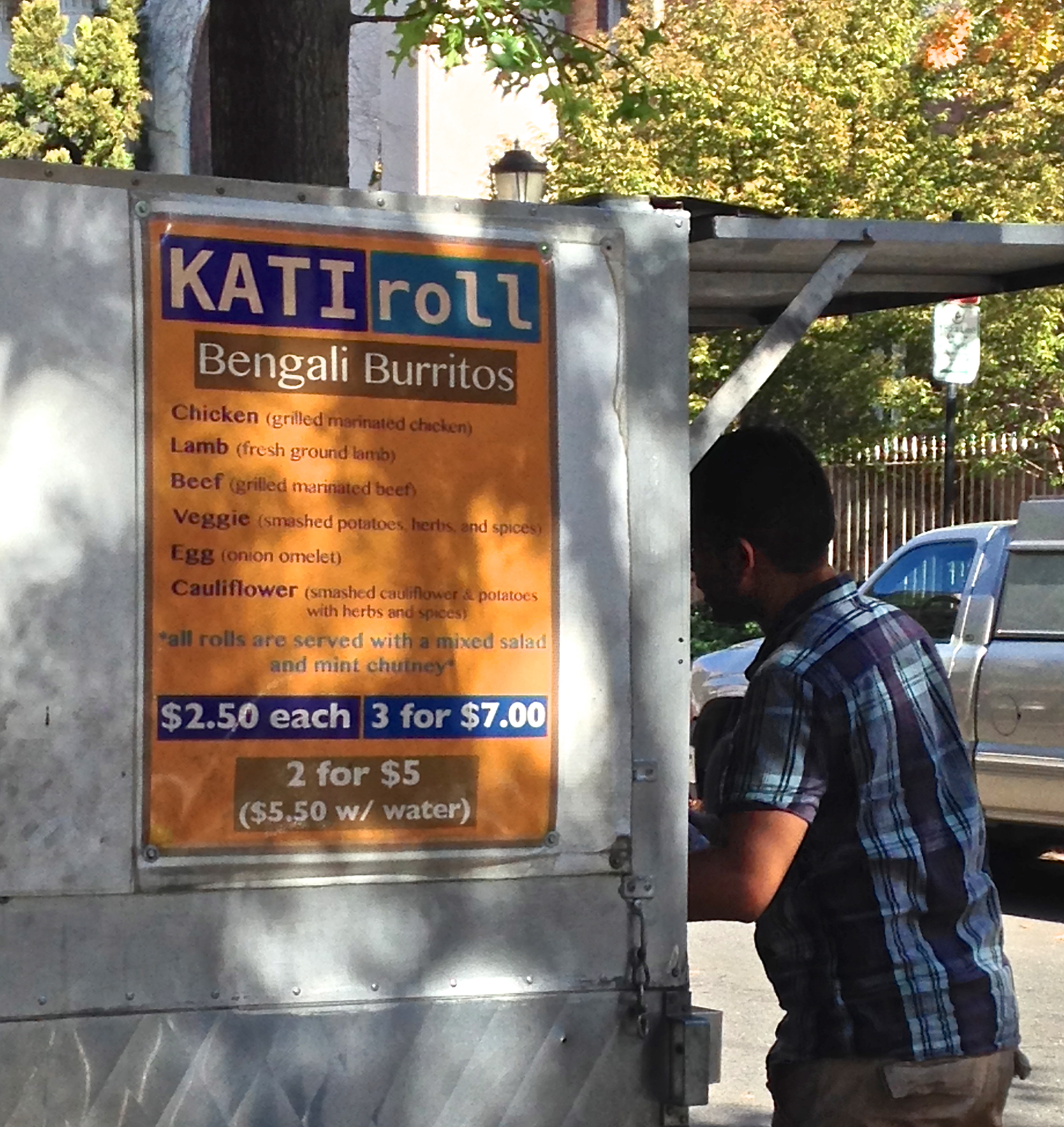
Bengali burrito cart, Oct 2013

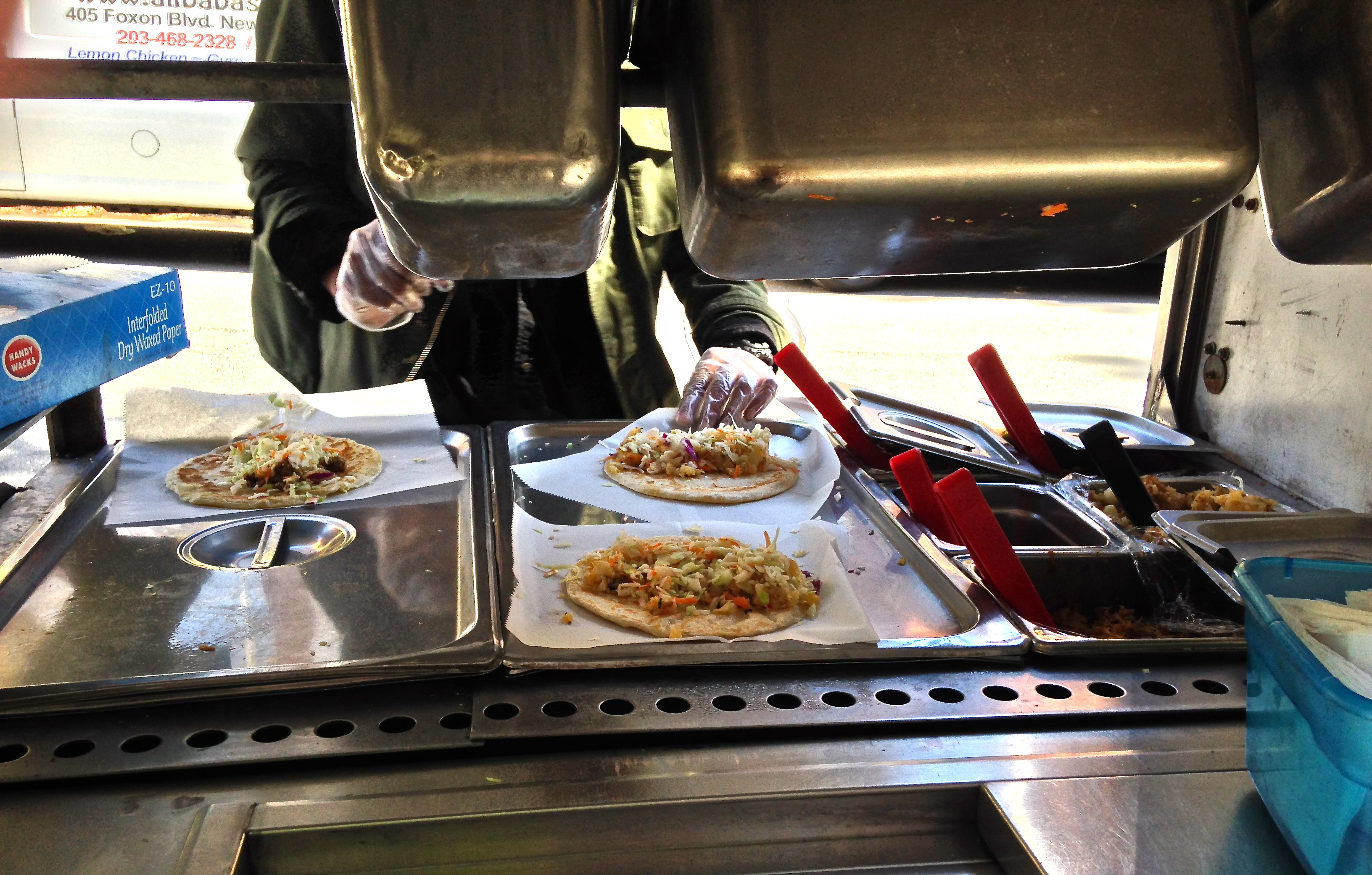
It was the food carts that steered me away from food deserts. I was vaguely aware of them my first visit, but this trip I discovered them big time. There are apparently 3 main concentrations in New Haven: Long Wharf, the part of campus known as Science Hill, and the one I most frequent which occupies a stretch of Cedar Street outside the Yale-New Haven Medical Centre. The cuisines on offer here are predominantly Asian, so a non-cheese lunch should be no problem. There are stir-fries, Taiwanese noodle soups, bibimbaps and—wow, Bengali burritos. I’m fascinated by cultural and culinary hybrids, so of course that’s what I order: one beef and one vegetarian. Then unroll them to see what’s inside: onion, cabbage, carrot, lightly spiced beef or potato all topped with chilli sauce, a yoghurt/mint dressing and a sprinkling of lettuce. The enclosing bread is a paratha, or maybe a roti—I’m never entirely sure of the difference between these 2—and the whole thing is delicious. Cheese free and not too big. Like the original Mexican burritos before they got supersized into American fast food.

IMG_0548

The burrito has a lot of creation stories, but most agree that it arose in northern Mexico and migrated along with the farm labourers to California and elsewhere. It existed on the culinary borderlands for several decades before becoming widely available in the 1960s—in the US. I don’t know when burritos first appeared on Australian menus …

The Tex-Mex chain Taco Bell opened in Sydney in 1981, relaunched in 1997, and by 2005 had pulled out of the country. Should you have a sudden craving for their fare, our nearest Taco Bell is now in Honolulu.

A burrito consists of a wheat flour tortilla wrapped around a filling. In Mexico they’re generally small and slim, with only a couple of ingredients—a little meat or fish, plus rice or beans. In the US burritos are longer and fatter, stuffed with way more than the basics.

The land of plenty. It drew the poor and huddled masses across the Atlantic, and it permeates American politics, values and eating habits. The belief that bigger is better seems to hit some kind of national sweet spot. Everything becomes bigger, not just burritos. Take nouns—US English supersizes them with extra syllables: transport becomes transportation; wonder lengthens into wonderment.

Salsa overtook ketchup as America’s favourite condiment a while back. Now tacos and burritos have pretty much lost their ‘ethnic food’ tag, and tortillas outsell burger and hot dog buns. The food of its southern neighbour is America’s food of choice even as armed vigilantes trawl the US-Mexican border for illegal immigrants.

Belgali burrito making

You can tell a lot about a place from browsing the cooking section of its bookshops. So having read about this conquest by quesadilla and a million jars of salsa, I decide to check out New Haven’s biggest bookstore. This  branch of Barnes & Noble has shelves of special diet books, loads of picture books about cupcakes, and plenty about modern American cooking using local and/or healthy ingredients. France is well represented, likewise Italy, and there’s quite a large Jewish section—larger than we’d see in Australia. By contrast, Asia is scarcely a dozen titles. I expect Mexico to be well-supplied … but it’s not. I count only 5 books. Wow again. This cuisine’s history may barely register in the official American story, but go to the supermarket and you find aisles packed with hot sauce, corn chips, frozen enchiladas, DIY tamales, etc. And there are Latino restaurants and food outlets all over the place. Maybe that’s it? Mexican food has been embraced with gusto—as an everyday, workaday, ‘blue-collar’ cuisine.

Once upon a time in Australia we got all our Mexican tastes by way of the US—heavy on sour cream, short on subtlety. Taco Bell may have upped and left, but over the past few years other Mexican themed franchises have spread across the country: Mad Mex, Montezuma’s, Guzman Y Gomez, Taco Bill’s. But alongside this ‘casual dining’ expansion I’ve noticed growing interest in Mexico’s rich and incredibly varied regional traditions. No mountains of guacamole going brown at the edges. No blizzards of cheap grated cheese.

The burrito is portable, adaptable, a constant work in progress. I’ve seen burritos wrapped around leftovers; around salad and sautéd tofu; Korean-Mexican fusions with kimchi and bulgogi; kosher burritos packed with pastrami; breakfast burritos with bacon and egg and the inevitable cheese. As for the Bengali burrito, a.k.a. kati roll, it’s not so much cross-culinary invention as an exercise in linguistics. A description for locals more familiar with Mexican food than that of the subcontinent. The kati roll is a popular street food from Kolkata. Like the burrito, there are many stories about its origins, and like the burrito it accommodates a diversity of fillings: Thai and Chinese as well as pan-Indian.

And the exchange runs both ways. Bangalore hosted India’s first Taco Bell in 2010, and in 2012 the company introduced its own take on the kati roll in its Indian stores: the ‘Kathitto’ is a combination of kati roll and Mexican-inspired burrito.

Bengali burrito

My desire for cheese-free lunches takes me back again and again to the food carts on Cedar Street. Don’t get me wrong, I like cheese—in its place. Cheese that tastes of something. It’s bland, mass produced American ‘Jack’ cheese I dislike. I can’t understand why anyone with any degree of kitchen literacy would buy it. Until I read about Dairy Management …

As well as pushing to expand the use of cheese in processed foods and home cooking, Dairy Management teamed up with Domino’s to develop a new line of pizzas with 40% more cheese. The pizza may have improved Domino’s financial health, but one slice contains around two-thirds of the maximum recommended daily intake of saturated fat. And you know what’s really bizarre? Dairy Management is a marketing creation of the US Department of Agriculture—the same agency at the centre of a nationwide anti-obesity drive—Go figure. The cheesiest of the Domino’s bunch is called the Wisconsin 6 Cheese Pizza. It’s not available—as far as I can ascertain—in Australia. But if it were, this is what you’d get: 6 cheeses on top (mozzarella, feta, provolone, cheddar, Parmesan & Asiago) and 2 more in the crust. Sounds like it should come with a coupon for the cardiac unit, doesn’t it?

The Bengali burritos are popular with staff and students from the hospital and surrounding departments. The food carts are an important part of New Haven’s eating environment, and they’ve shifted my thinking about New Haven, and about American food more generally. Yes, I can see the downside: the poverty, the waste, the wages so low that people have 2 and 3 jobs to survive and no time to shop and cook. But I can also see that it’s a country where fusion—culinary and otherwise—occurs with ease and frequency.

Cheese in art

I remember a calendar. A gift from a family friend who’d been on holiday to the Netherlands. A different Dutch Cheese for every month. Most of the pictures were photographs, but there was a map of the different cheese areas, and a couple of paintings. Still Life with Pewter Jug, Fruit and Cheese plus another whose name I’ve forgotten, but which also dated from the early 1600s—from the period known as the Dutch Golden Age.

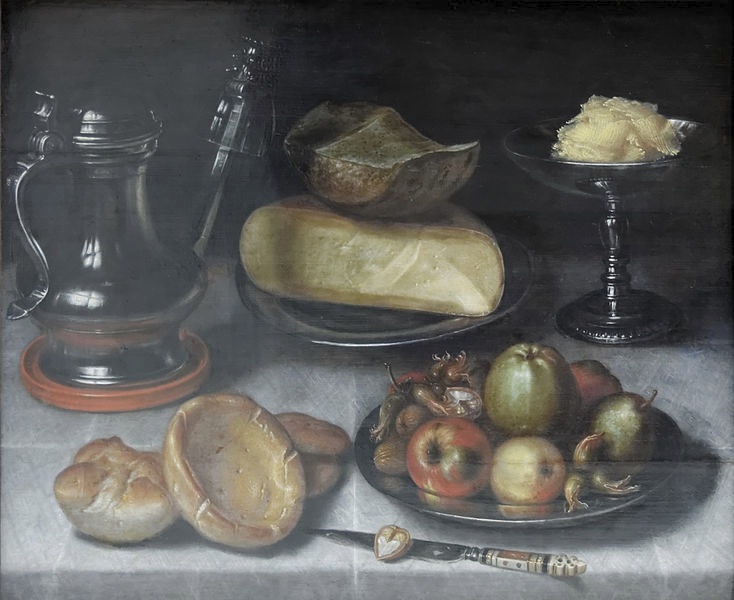
Floris van Dijck, Still life with pewter jug, fruit and cheeseFloris van Dijck, circa 1615-20

Still life painting flourished as a distinct genre during this time, the opening decades of the seventeenth century, a time of unprecedented prosperity. Instead of portraits and religious scenes, artists started painting things: candlesticks, canisters, flowers—and food. Lots of food. Local produce as well as exotic ingredients shipped in from the various Dutch colonies. The spectre of slavery hovers over these tables of plenty.

Cheese is centre-stage, an anchoring presence, in many of these delicious paintings. It was, after all, one of the pillars of the Dutch economy. Its meaning mercantile and domestic rather than religious. Near the beginning of Daniel Defoe’s Robinson Crusoe, published in 1719, the newly ship-wrecked Crusoe compiles an inventory of his salvaged cargo: ‘bread, rice, three Dutch cheeses … ’

I’m fond of the novella form, and in 2007, during a stay in Amsterdam, I discovered Cheese. Kaas in Dutch. It’s a comic gem, ‘Edam’s great moment in world literature,’ according to its English publisher. Written by Willem Elsschot, a Flemish author and advertising executive, published in 1933, it’s both absurdly funny and terribly sad. Frans Laarmans is a shipping clerk in Antwerp. Pushing 50, on the corporate road to nowhere, he wants respect more than riches. To that end he becomes the Belgian sales agent for a Dutch cheese exporter and takes delivery of 10,000 wheels of Edam. But instead of concentrating on shifting his supply he focuses on setting up his office—buying a desk and typewriter, ordering letterhead, and so on. Meanwhile the cheese sits there, crates of it …

And Laarmans doesn’t even like cheese:

‘I stopped outside a cheese shop to admire the window display … Huge Gruyères as big as millstones served as a base, and on top of them were Cheshires, Goudas, Edams and numerous varieties of cheese that were entirely unknown to me, some of the largest with bellies slit open and innards exposed. The Roqueforts and Gorgonzolas lewdly flaunted their mould, and a squadron of Camemberts let their pus ooze out freely. An odour of decay wafted from the shop.’ From Paul Vincent’s English translation, 2002.

Must admit I identify with Laarmans on the matter of stationery. When I’ve got a deadline or some other urgent task, there’s nothing like a nice delaying trip to Officeworks or Dymocks to buy that all-important pencil or plastic wallet.

But it’s not only fine art and high culture. ‘That’s it Cheese! We’ll go somewhere where there’s cheese!’ exclaims Wallace in the animated short A Grand Day Out. And off they rocket to the moon, because as everybody knows, the moon is made of cheese. It plays a role in most of the Wallace & Gromit films, and in A Close Shave Wallace declares Wensleydale his favourite cheese—a preference credited with boosting sales of the crumbly Yorkshire staple.

Clara Peeters-Still life with cheeses, artichoke, and cherries c1625

Still Life with Cheeses, Artichoke and Cherries was painted by the Flemish artist Clara Peeters circa 1625. I doubt it was the other painting in that calendar of Dutch cheeses, but it’s interesting to note that there were women artists of the Golden Age.

Traditional art history read these luminous still lives as expressions of disapproval, criticisms of luxury and sinful excess. But others question that interpretation and argue for a more layered understanding. Me, I see them as feasts for the senses, celebrations of both life and life’s transience. The French term for a still life is ‘nature morte’ which translates as dead nature. Some of these Golden Age still lives include a dead fish or fowl, a peeled fruit starting to rot, even a part-eaten pie. Many of the featured cheeses are wedges, half-rounds, blocks with a corner cut off—someone’s breakfast perhaps? Peeters’ painting is more of a close-up than many. If you look carefully at the large pale cheese on the silver plate, you can see knife marks, slightly darkened edges where it has begun to dry out, a gouge where a plug sample was removed for testing.

These reminders that worldly pleasures are fleeting, remind me of those much quoted (but alas rarely referenced) lines by W H Auden: ‘although the great artists of the past could not change the course of history, it is only through their work that we are able to break bread with the dead, and without communion with the dead a fully human life is impossible.’ BTW it’s from his lecture/essay Words and the World published in Secondary Worlds, 1968.

As for that tear-off calendar, well, it did teach me that there was more to Dutch cheese than waxy red-coated Edam. My favourite was—still is—Leiden (or Leyden). That’s the one with cumin (and sometimes caraway) seeds.

Have you heard of the bullace?

‘Beautiful spring weather,’ wrote George Orwell in 1940. ‘Heard the cuckoo (first time). Many midges about now. Bullace blossom pretty well out.’ The man who took us down The Road to Wigan Pier and into the dystopia of Nineteen Eighty-four once said: ‘Outside my work the thing I care most about is gardening.’ And his diaries bloom with sunflowers, cabbages, marigolds—and plums. Because that’s what the bullace is: a member of the large plum family.

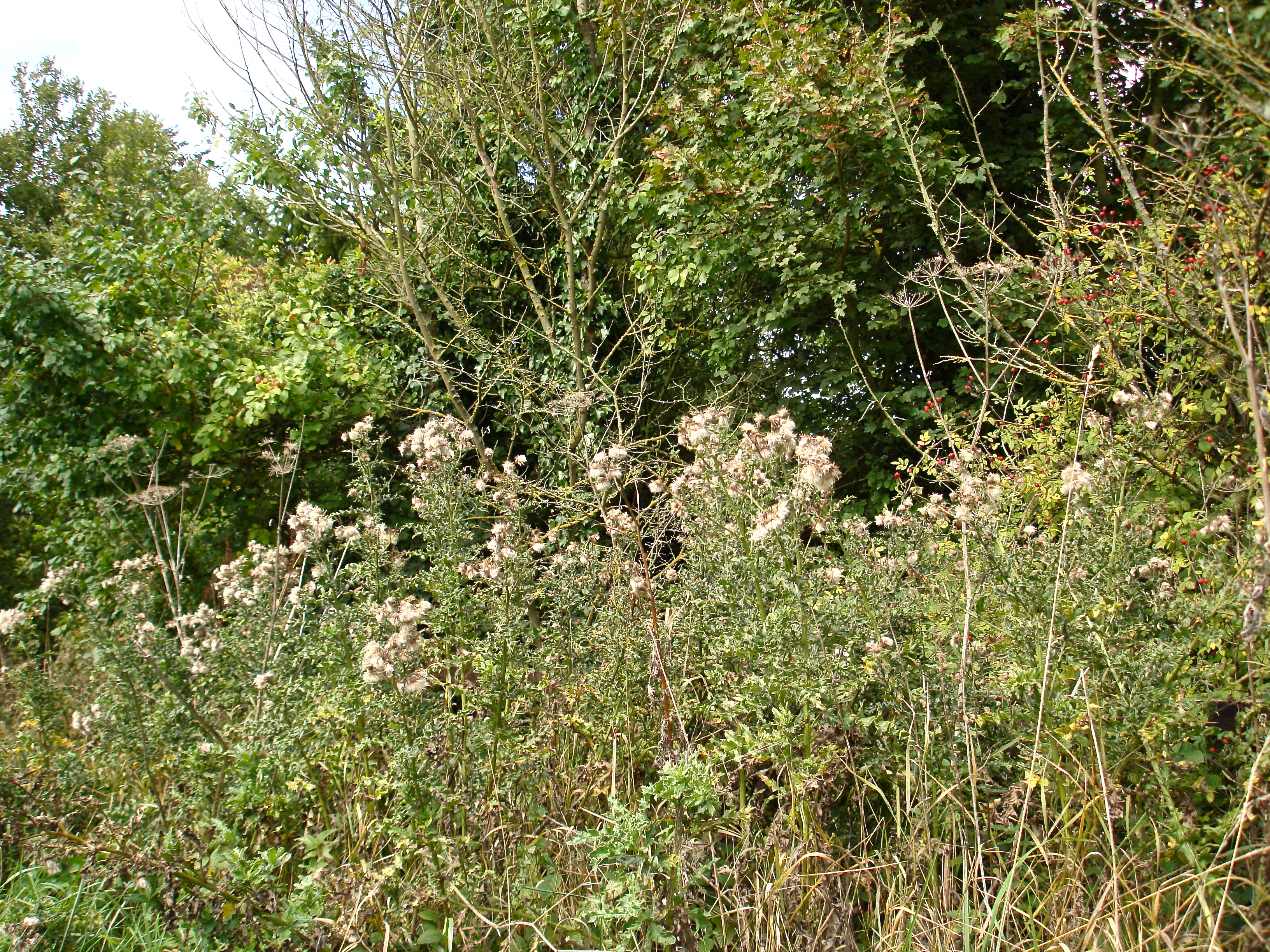
Plums herald the glorious glut-months of late summer, when stone fruits are cheap and plentiful—and autumn is just around the corner. (It’s probably un-Australian, but I don’t like summer and am always relieved when we reach the season’s hinge.) You might these days find more varieties of plums at growers’ markets than in the supermarket, but I bet you won’t find any bullaces. I’d never heard of them until a few years ago. I was visiting my mother in England; it was the end of September and the hedgerows were a mass of plants grumbling for sun and air. Heavy with thistle-down, rose-hips, and a small oval fruit my mother popped in her mouth before I could say: Don’t eat that! It could be poisonous, you don’t know what it is.

But she did know what it was: a bullace.

Archaeologists have unearthed bullace stones dating back to Saxon Britain and before, but there’s no consensus about whether the bullace is an English native or an early import. For horticulturalist H V Taylor (The Plums of England, 1949) it’s ‘the only truly English plum’, whereas John Lewis-Stempel (Foraging: The Essential Guide to Free Wild Food, 2012 ) says it’s ‘not native to these isles’ and was brought to Britain by the Romans.

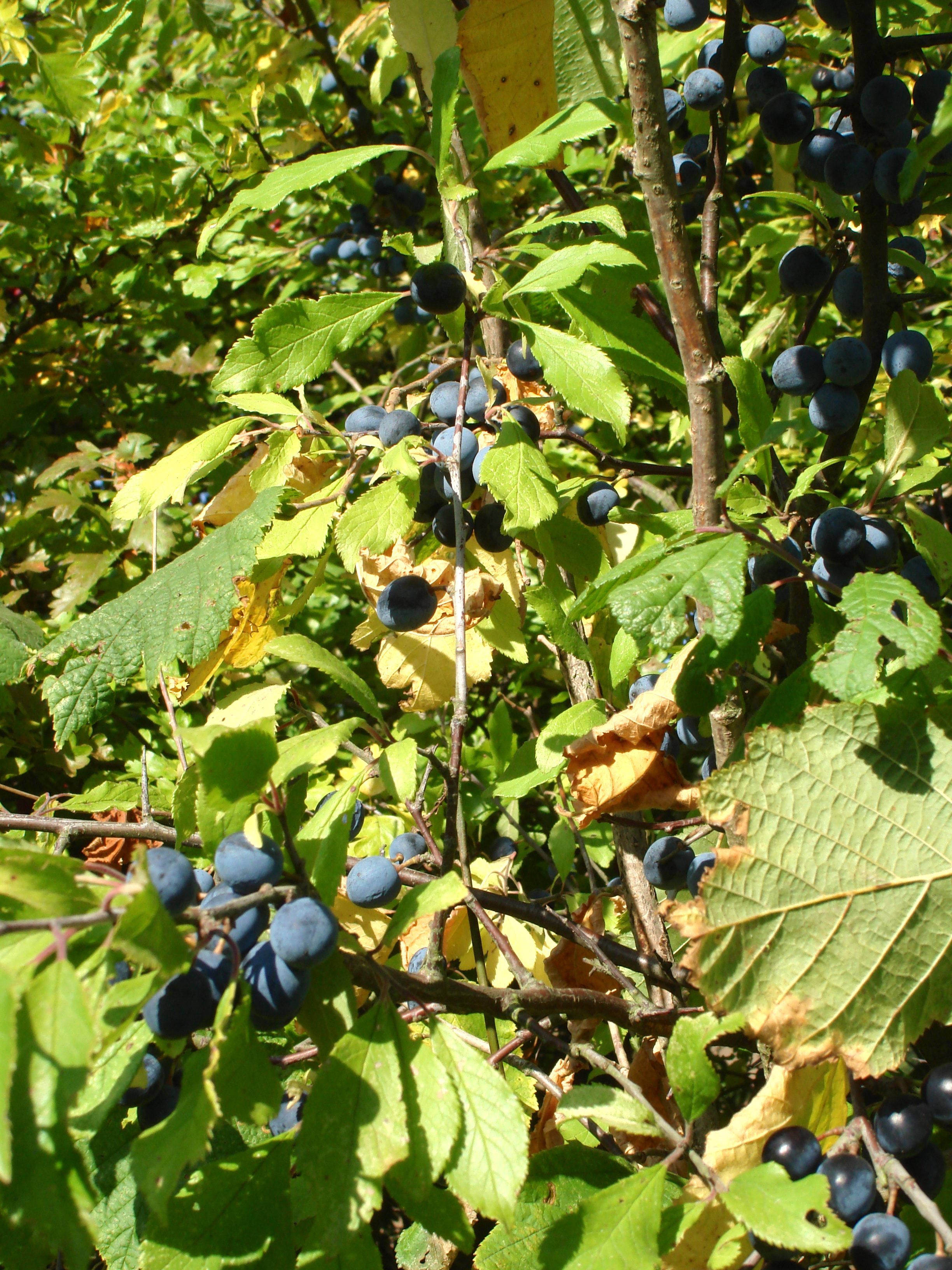
Together with damsons, the bullace belongs to the insititia subspecies of Prunus domestica. Unlike damsons though, bullaces come in different colours. Some varieties are ‘Black’ i.e. dark bluish purple, others have yellow flesh and are called ‘White’. Dark varieties of bullace resemble damsons, but they usually ripen 4—6 weeks later. The dark varieties also get confused with the closely related sloe  a.k.a. blackthorn. Actually the presence or absence of thorns is an easy way to distinguish the two: If the tree or bush is thorny you’re looking at sloes. Bullace plants are thorn-free.
Sloes again, England, Sept 2010 copy

The bullaces my mother and I picked that day had yellowy-green skins with a red blush. Their flavour was tart, so I made them into jam. During the first decades of the twentieth century commercially produced plum jam was the default, and many low-income households saw no other kind. Decades later, plum jam was still the cheapest option. All the jam we ate when I was growing up was homemade, but I remember seeing tins of IXL plum jam imported from Australia in the school kitchen.

According to my mother, bullaces and damsons make a tastier, more complex jam than regular plums—which can produce a bland confection. Even so, she recommended the addition of cinnamon or orange zest and/or a slug of Cointreau to ‘liven up’ my bullace jam. Another option is to gather some blackberries and crab apples along with your bullaces and make an autumn hedgerow jam.

Do we have bullaces in Australia? That wonderful reference The Complete Book of Fruit Growing in Australia mentions them briefly, by way of background, in its chapter on stone fruit. But I’ve never seen bullaces here, and I suspect most contemporary gardeners would agree with Walter P Wright (An illustrated Encyclopaedia of Gardening, 2010) that the bullace is ‘a fruit hardly worth growing’. I don’t think that, nor did the cooks of the past: Mrs Beeton suggested bullace pudding as part of a Sunday menu; you come across recipes for bullace cheese (a kind of plummy fudge) in a number of nineteenth century cookbooks, while The Country Housewife and Lady’s Director in the Management of a House, and the Delights and Profits of a Farm, circa 1732, tells you how to preserve your harvest: 

Take your Bullace before the Frost has taken them; let them be fresh gather’d, and clear Fruit, scald them in Water: then take their weight in fine Sugar, with a little Water, and boil it to a Syrup; then put in your Bullace, and boil them till the Syrup is very thick, and your Fruit very clear.’

I’ve made damson curd (like lemon only with damsons) and because bullaces have a similar sharpness I reckon you could also make curd with them. Odd things curds, a preserve but not quite a preserve … a subject for anther post perhaps?

What else? Well, bullace vodka, of course. Lots of recipes for this, but here’s mine: For every litre of vodka, add about 450 grams of bullaces, and about 100 grams of sugar. Wash the bullaces, remove any leaf litter and pierce the skin of each fruit with a knife-point. Put them into a large glass jar, add the sugar (taste it in a month and add more sugar if you want a sweeter taste) and vodka. Make sure the lid is on tight, and shake. Store in a dry, dark place. The first few weeks, give it a daily shake, then once or twice a week. It’ll be ready in 3-4 months, the sugar will be gone and it’ll have a slightly treacly texture. Decant it carefully through a fine mesh into a bottle/s. Makes a nice gift—or you can drink it yourself.

Śliwowica or slivovitz is produced commercially and in back rooms and outhouses across central and eastern Europe. The name derives from the various Slavic words for plum. It’s śliwka in Polish, śliwki for plums plural, and the spirit distilled from them (śliwowica) gets translated as both plum vodka and plum brandy. Amongst Jewish communities śliwowica is a popular tipple during Passover when grain-based alcohols are forbidden. It’s usually a clear liquid, but your bullace vodka will be either inky-dark (like sloe gin) or a deep rusty red, depending on whether you use black or white bullaces.
Meesden hedgerow 2010

This photo isn’t enough of a close up to see them, but it’s one of the hedgerows in north-east Hertfordshire where we collected our bullaces that day in September. I can’t say whether they were wild, garden escapees, or some kind of hybrid because, as H C Watson wrote to Darwin in 1855, ‘between the plum-tree of the garden & the sloe-bush of the hedges, there exist numerous intermediate forms or links’. What I can say is that during the late eighteenth and nineteenth centuries fruiting trees and shrubs like sloe and bullace were sometimes planted around the edges of enclosed fields and woodlands to provide food for the peasantry …

Sydney, 1914, a visiting English geneticist called William Bateson gave a lecture about heredity. I’m paraphrasing, but he used this analogy to explain the nature/nurture relationship: The peasant was a bullace, the upper class a cultivated plum. With the right nurturing the bullace could become a better bullace, ‘but plums they can never be.’ Hmm.

I began this post with a writer so I’m going to end it with 2 more literary references to the bullace.

Instead of the familiar ‘sloe-eyed’ how about this comparison from a seventeenth century ballad A Sing-Song on Clarinda’s Wedding by Robert Fletcher:

‘The sparkling bullice [sic] of her eyes
Like two eclipsed suns did rise’

And from Christina Rossetti’s Goblin Market:

‘Morning and evening
Maids heard the goblins cry:
“Come buy our orchard fruits …

Pomegranates full and fine,
Dates and sharp bullaces,
Rare pears and greengages,
Damsons and bilberries,
Taste them and try … ”’

This long narrative poem is about sisters Laura and Lizzie, and temptation: One sister succumbs and is soon wasting away. Can sisterly love save the day? As poetry I don’t find Goblin Market terribly interesting. What is interesting is that although Laura partakes of the forbidden fruit, she doesn’t suffer the fate of most ‘fallen women’ in Victorian literature. She doesn’t die, quite the opposite: she lives to tell the tale. Bit like the bullace, in fact.
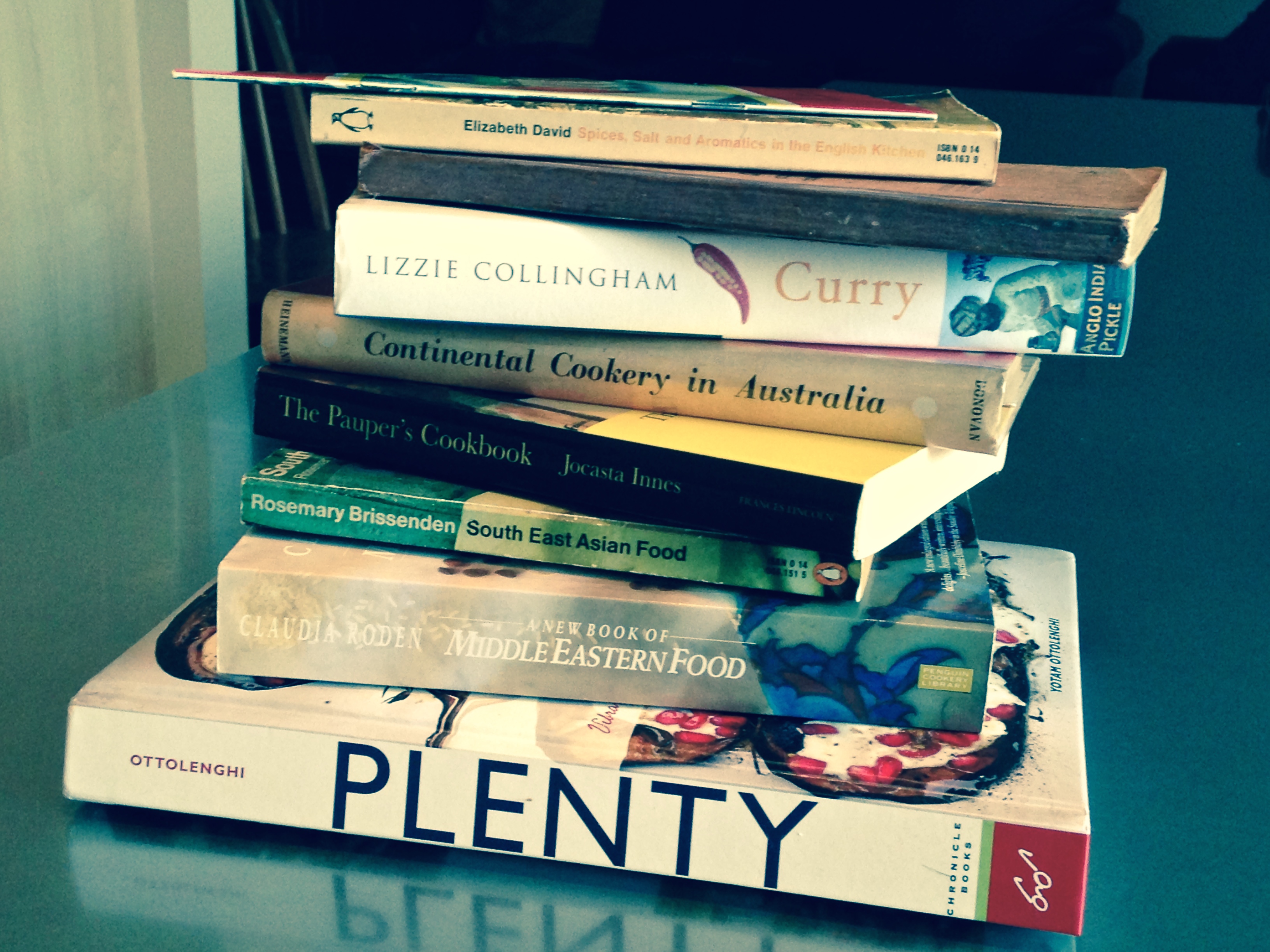
My Life in Cookbooks

I’ve got a food-related radio feature coming up. My Life in Cookbooks goes to air this Sunday 4 August on ABC Radio National’s 360documentaries program. It’s written and narrated by me (with contributions from keen and not-so-keen cooks), produced by Lea Redfern and sound engineered by Russell Stapleton.

My Life in Cookbooks 4

A personal library reflects the passions and preoccupations of the collector, and cookbooks are no exception. From my own shelves I measure out a narrative in several chapters—from (almost) the very first cookbook I bought as a university student in the late 1970s (The Pauper’s Cookbook) to the one I bought last month (Plenty).

Cookbooks reflect the societies that produce them. My Life in Cookbooks is about reading between the lines and against the grain. It’s about the allure and shortcomings of cookbooks. The feasts they promise and the meals they serve up. It’s about changing notions of gender and domesticity. About multicultural Australia. And it’s my individual take on our complex relationship with food and cooking.

Hope you can listen to it—here are the details:

My Life in Cookbooks
ABC Radio National: 360documentaries
Sunday 4 August at 10:00 am. Repeated Friday 9 August at 2:00 pm
You can also listen online and download the program for 4 weeks from initial broadcast.
http://www.abc.net.au/radionational/programs/360/

Chestnuts etc

Chestnuts and winter go together like—well, chestnuts and winter. They also go well with Jerusalem artichokes. Ditto roast meats, bacon, sausages, and most of the brassicas (cabbage, kale, cauliflower, broccoli, bok choy, Brussels sprouts). Not to mention chocolate.

There are several species of sweet chestnut. They all belong to the genus Castanea, but trace their origins to different regions: C. crenata and C. mollissimo come from from China and Japan, C. dentata from North America, C. sativa from Europe and Asia Minor. Unless you’re a grower, that’s probably all the botany you need.

1379019 copy

I’ve bought chestnuts hot off braziers in French railway stations and wrapped in cones of newspaper from vendors in Korea. They’re a winter street food, resolutely seasonal, and they taste of the Northern Hemisphere—even if I’m eating them in Sydney.

As kids in England, come autumn we’d amass collections of acorns, beech nuts and conkers. For what purpose, I’m not sure. Certainly not to eat them, they’re all horribly bitter—I know because of course we tasted them, the way children do despite the warnings of grown-ups. I was particularly perplexed by conkers, the fruit (technically the seed) of the majestic horse chestnut tree, because I knew that people did eat chestnuts, and I assumed conkers and chestnuts were one and the same. The only explanation I could come up with was that the people who ate them must be dreadfully poor and unable to afford ‘normal’ food. Now I know that although conkers look like chestnuts and the tree’s common name adds to the confusion, the horse chestnut and the sweet or edible chestnut are not close relatives. The horse chestnut, which produces beautiful spring blossom, abundant summer shade, but nothing remotely edible, is a member of the genus Aesculus.

Horse chestnuts may not have been a source of human nourishment, but their sweet namesakes have a long history as a staple. Before corn arrived from the New World polenta was made with chestnuts. If you can find it, coarse chestnut flour, mixed with regular corn polenta in a ratio of about 1:3, makes a great mash. Goes well with mixed mushrooms or a chunky meat ragù.

Chestnuts 1

Chestnut cultivation has provided fertile ground for environmental historians. A valuable lens through which to analyse the changing patterns of the culture-nature kaleidoscope. If you read French there’s Ariane Bruneton-Governatori’s Le Pain de Bois: Ethnohistoire de la Châtaigne et du Châtaignier. The eponymous wooden bread (le pain de bois) was what peasants in Italy, Corsica, Portugal and elsewhere called the literally flat bread they baked with chestnut flour. Landscape and Change in Early Medieval Italy: Chestnuts, Economy, and Culture by Paolo Squatriti is a microhistory, a different angle on supposedly familiar territory. Here’s an appetiser on Google Books.

If chestnuts and winter go together so do chestnuts and books. John Clare’s poem The Winter’s Come opens with ‘Sweet chestnuts brown, like soleing leather turn’ before proceeding to ‘’Tis Winter! and I love to read in-doors … ’ Over 130 years later, the Polish poet Czesław Miłosz, likened books to ripe chestnuts:

And yet the books will be there on the shelves, separate beings,
That appeared once, still wet
As shining chestnuts under a tree in autumn,
And, touched, coddled, began to live
In spite of fires on the horizon, castles blown up,
Tribes on the march, planets in motion. (And Yet the Books, 1986)

French has 2 words for chestnuts (so does Italian, and maybe other European languages too). Châtaigne is the generic term, while marron is reserved for the big, highly cultivated chestnuts that grow singly, one in each nut-case.

From a culinary point of view the big issue with chestnuts is getting them out of their shells and skins. They don’t come with instructions, but the internet is awash with advice and techniques. I soak them in cold water for about 30-40 minutes, score their casings with an X and roast them in the oven for about half an hour. Once cooked, the tough brown husks come off quite easily, but it can be fiddly getting rid of that fine, fibrous undercoat.

Although a few random trees were planted by early settlers, chestnut farming in Australia didn’t get going until after World War II, thanks largely to Italian migrants who were obviously looking to the future. The trees don’t start to bear fruit until they’re at least 15 years old, and don’t reach optimal yield until 50, so you’re thinking ahead, long-term, when you plant C. sativa. Doing it not so much for yourself but for generations to follow.

Chestnuts 3

I’ve blended crushed chestnuts with icing sugar then mixed it up with broken meringue, whipped cream and grated chocolate to make a dessert that’s Mont Blanc meets Eaton mess. On the savoury front, a classic comfort dish is the Korean kalbi or galbi jjim or tchim. In Hangul it’s 갈비찜 and it’s a rich, mellow stew of marinated beef-on-the-bone (traditionally short ribs, but I’ve also made it with veal shanks), slow-cooked with carrots, onion, daikon or Korean radish, mushrooms, a nashi pear—and chestnuts. It’s one of those flexible recipes that’s hard to stuff up and people adapt every which way. Throw ‘galbi jjim’ into YouTube and check out the cooking demos.