Salsify. Can you buy it in Australia, and if so, where?
I came across this article from the Glen Innes Examiner in the course of searching for information about salsify. Did it—does it—exist in Australia beyond sporadic mentions in gardening manuals and seed catalogues? Glen Innes, BTW is a town in northern New South Wales, about 570 kilometres from Sydney. The piece begins:
‘Canberra may worry itself—perhaps it doesn’t—about the accelerated rate of foreign migration to Australia. Ministers may call—perhaps they don’t—anxiously for reports on the rapid influx of aliens, to use the most unfriendly term, and its threat to our Anglo-Saxon racial predominance.’
With much heated, sometimes verging on hateful, debate about immigration taking place in Australia and elsewhere, this opening paragraph caught my attention. It could have been written now—but it wasn’t, it’s from 1938 not 2026.
Books, theses and thousands of words have been circulated about how twentieth century migration, the post-WW2 influx in particular, widened Australia’s foodways. As the anonymous author of A Question of Legumes notes, salads ‘have expanded under foreign influence’ and there’s a revolution taking place in the vegetable garden.
‘Even a cursory glance in the windows of the fruit merchants these days reveals that there are more things vegetable in earth, at all events than have been dreamed of in our Anglo-Saxon philosophy. One day this week I saw, for the first time in my life in Australia, the succulent salsify in a city fruiter’s.’
Because my partner and I are in the middle of renovations, my library of culinary references, food histories and cookbooks is packed in boxes and inaccessible. So it’s from online sources—and memory—that I’d describe salsify as looking like a thin, dirty parsnip. It tastes a bit parsnip-y too.
It’s an unprepossessing tap root.
And I love (almost) all root vegetables.
In horticultural as well as culinary literature, salsify often appears alongside its cousin, scorzonera. Both are members of the large Asteraceae family. And you can use them interchangeably in recipes.
Salsify, Tragopogon porrifolius, is a larger relative of the wild plant, goat’s beard, and native to the lands around the eastern Mediterranean. Although it was probably eaten in classical times, cultivation began in France and Italy in the sixteenth century. In Britain it enjoyed a short-lived place in the sun, but has never been a mainstream vegetable. Today, France, Italy and Russia are the countries in which you’re most likely to see salsify being grown and eaten.
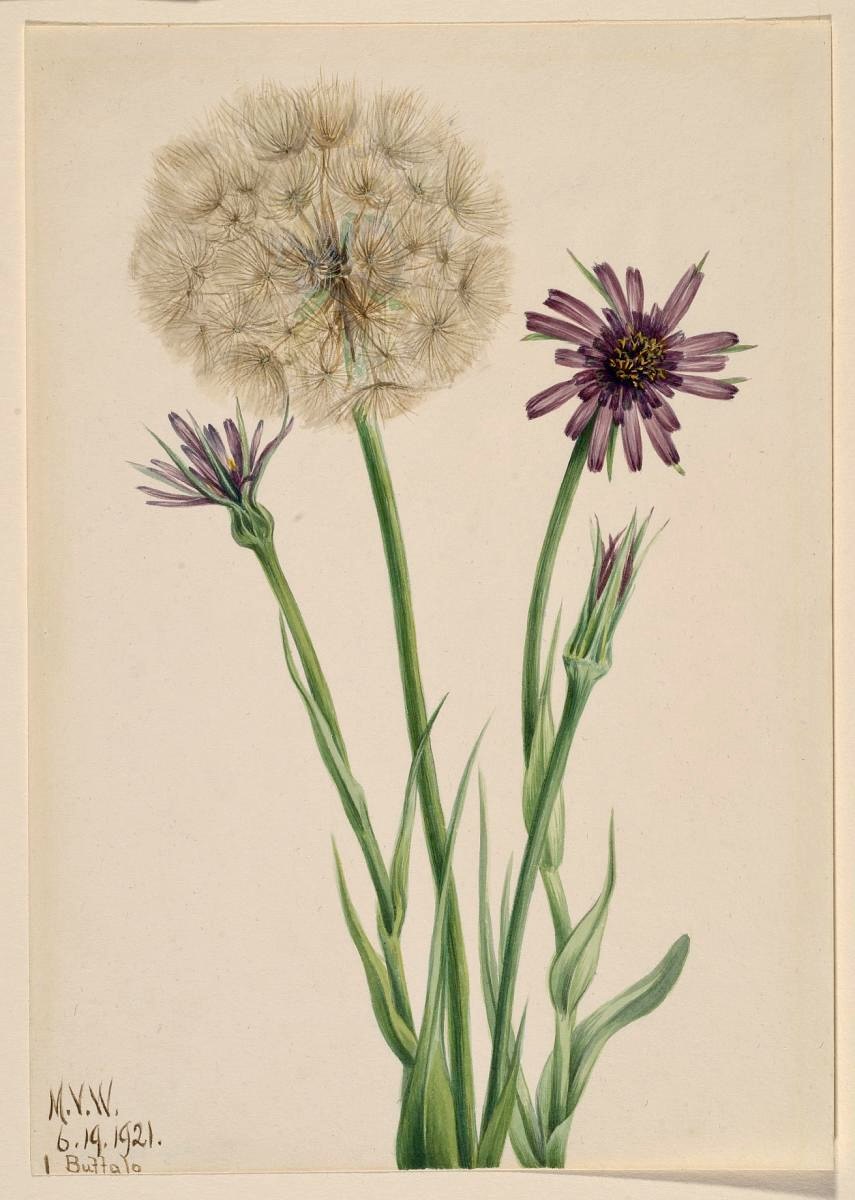
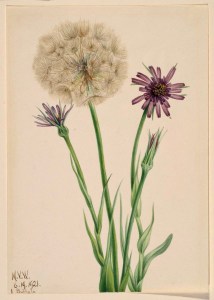 Salsify (Tragopogon porrifolius), watercolour on paper by Mary Vaux Walcott, 1921. Smithsonian American Art Museum.
An entry in The Australian Horticultural Magazine of 1878 suggests several ways to prepare salsify for the table—boiled, baked, battered and breadcrumbed. Or sliced like cucumber for a salad dressed with vinegar and pepper. Lamenting that it ‘is not so much cultivated in British gardens as formerly, and it is but seldom used in the Australian colonies.’
A sentiment echoed in the 1893 publication, The Art of Living in Australia: ‘The salsify, or “vegetable oyster,” is a typical example of a most unaccountably slighted vegetable with us.’
The entry continues with the following cooking advice: ‘It requires to be boiled slowly, in the smallest possible quantity of water, until it is almost ready to melt. If boiled fast, in abundance of water, the savour of both parsnips and salsify is to a great extent dispersed and lost beyond recall.’
Salsify and scorzonera are apparently super easy to grow. They require only a patch of decently drained soil and light watering should the weather turn dry. The main challenge is how to pull up those skinny roots without breaking them.
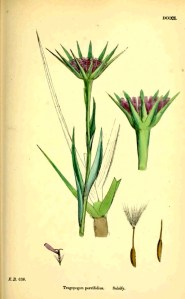 Tragopogon porrifolius. Salsify. from English Botany, or, Coloured Figures of British Plants, 1863 – 1886. Biodiversity Heritage Library.
I was introduced to salsify during a school exchange visit to France. I remember the fresh vegetable, peeled and baked in a gratin with cabbage. And canned salsify served with white wine and melted butter. Or in a mustardy, garlic infused vinaigrette. In fact, now I think about it, most of the salsify I’ve eaten in France has come out of a tin. In any case, fresh or canned, from that first bite I really, really liked salsify, and when I retuned to England I looked for it—in any form—in supermarkets, delis and grocery stores. Occasionally I’d find a can of it. On recent trips to Britain I’ve looked for it again, but to no avail.
In Sydney my search for salsify has taken me to farmers’ markets and speciality stores and to this wonderful website from master forager Diego Bonetto: How to Identify, Harvest and Eat Salsify.
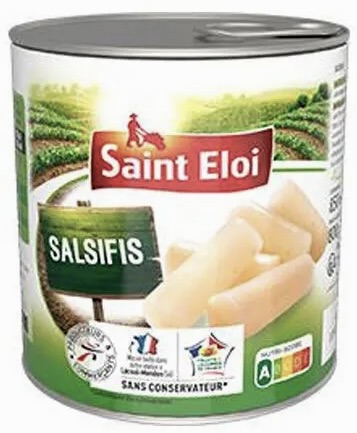
And it’s also taken me to France at Home, a place to online order French products in Australia—including canned salsify. I’ve bought a tin and it should arrive any day now.
It’s been such a long time, decades, since I tasted salsify—will it be the deliciously delicate vegetable I remember?
Let’s see …
Meanwhile, back to 1938 and the Glen Innes Examiner:
‘Salsify, like a good many other new vegetables our migrant friends have introduced here, finds little demand as yet except from the Italians and the too rare Frenchmen in our midst and from local Bohemians with a taste for cooking and strange foods and a library half filled with foreign cookery books.’

